A Spoiler-Free Review of Hamnet (2025) from an Ex-Theatre Kid
I was finishing up my last TIFF shift, working as an usher at the Lightbox, when I was informed that Chloé Zhao’s Hamnet had won the People’s Choice Award for the festival’s 50th year. I had gotten tickets to a screening of the film a few days prior, but was unable to attend due to schedule conflicts. When my venue showed the film throughout the festival, attendees would exit the screening, wiping away tears from their eyes while proclaiming that they’d just seen one of the greatest films ever made. As an ex-theatre kid with a tattoo of John Everett Millais’ Ophelia (1851-2), a film exploring the circumstances of William Shakespeare’s life that inspired Hamlet was right up my alley. I was eager to find a way to be an audience member during one of the last screenings of the movie, and after speaking with my supervisor, he (seeing the anticipation in my eyes) was able to arrange a reserved seat for me at the next showing. As I entered the full theatre with popcorn and a Diet Coke/Dr. Pepper concoction, I took my seat in the second-to-last aisle and waited patiently for the screening to start. The choruses of “Arghs” (as an anti-piracy warning was displayed on screen) were the last sounds heard from the audience before we entered into Zhao’s world together.
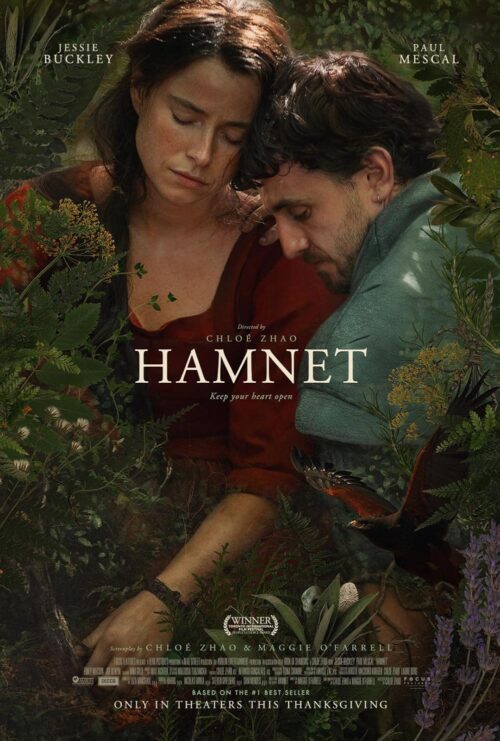
Throughout the first 30 minutes of the film, I was captivated by the cinematography. Luscious green meadows and an entrancing use of flora and fauna entertained my eyes while period-accurate costumes exemplified the realistic nature of the film. Though I found that the story had a slow start, by the film’s midpoint, all of the rising action came to a climax. It was at this point that those around me, as well as I, allowed our tears that had been threatening to come out to do just that. Through the anguished cries of Jessie Buckley as Agnes, the wife of Shakespeare, the audience truly felt the immense emotions that come with motherhood. Buckley becomes unrecognizable through her grief in this role and is a vessel for viewer insertion into the story.
The last 30 minutes of the film bring all elements of artistic expression and family values home through the onstage production of Hamlet, as viewers watch alongside Agnes. The production mirrors important aspects of Agnes and William’s life together, unbeknownst to the other hundred viewers of the tragedy. Despite their lack of knowledge of the story that inspired the play they watch, audience members on-screen sob and join in with Agnes in the paramount action of the picture. It is through the reactionary response of the Globe’s audience members that the messaging of the film becomes clear for audiences: we, too, are sitting here, not personally familiar with the real people the story is based on, yet we cry with them. We feel alongside them, and though we may not be mothers or fathers, we physically express the emotions portrayed by on-screen characters because we, too, are able to feel them. Agnes’ grief becomes a universal emotion for viewers both within the film and out, and moves people to understanding.
After the applause passed and the credits rolled over a soft melody, I remained seated. Looking around at these strangers that I had just gone on this immense journey of emotion with, it seemed that they were left with the same feeling of astonishment as me. We had all just played an active role in the film, one as important as any other cast member, and we were not sure where to go from there. It is with reluctance that I stood up, wiped away my tears, and walked out of that theatre. As I passed my co-workers, they noticed that my face was beet red from having cried through two-thirds of the film, and I expressed my praise to the winning picture I’d just had the privilege of seeing. Walking out onto King Street, heading towards the subway home, I listened to Mitski’s “Working for the Knife” on repeat. The lyrics “I cry at the start of every movie / I guess ‘cause I wish I was making things too” encapsulated my feelings of amazement about the film alongside a self-deprecating belief that I would never be able to create something as movingly brilliant as what I had just seen.
I urge anyone interested in this film to break out of their comfort zone and go see this film alone, in a theatre full of strangers. It too will move you.