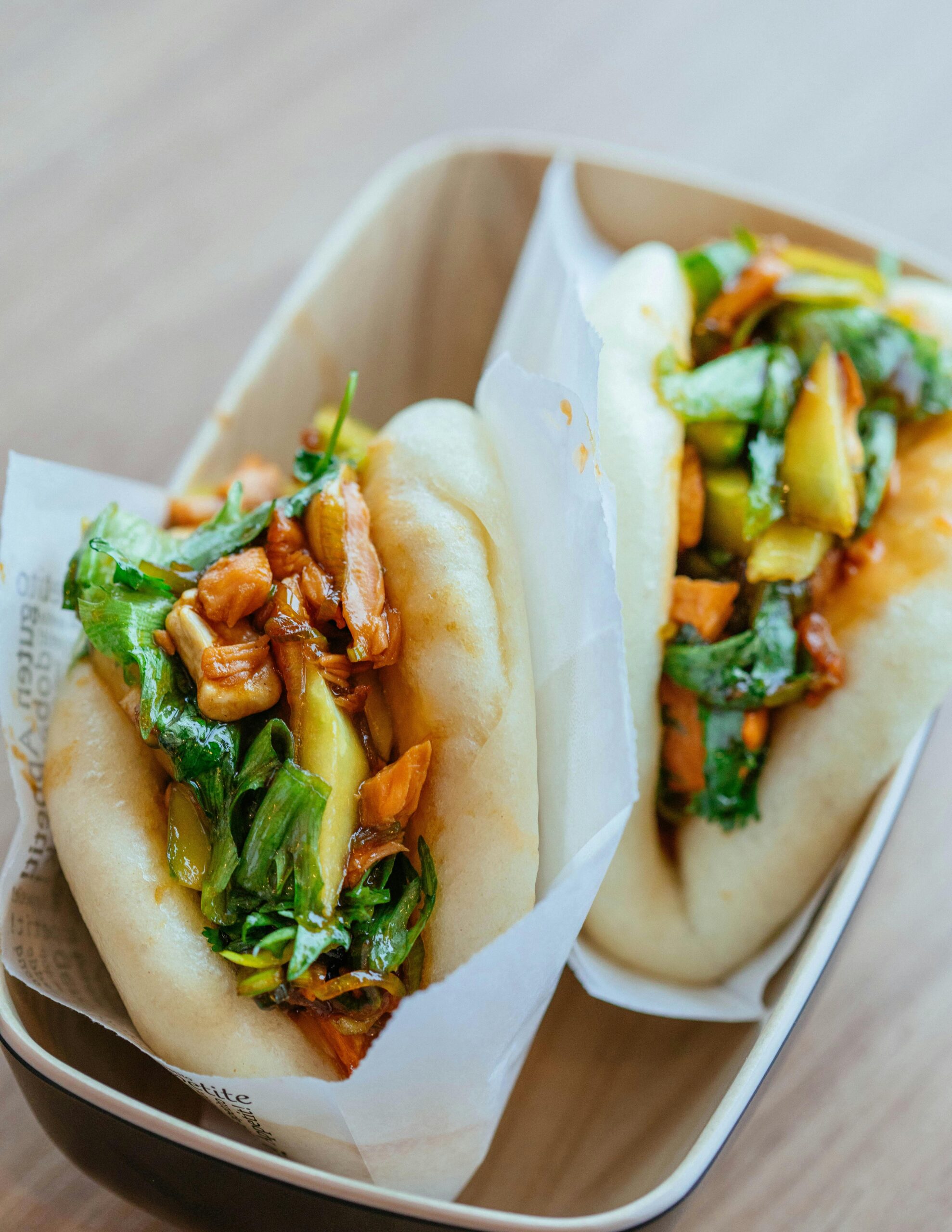
Big Round Tables: Dining at Bao Restaurant Chinatown
When I flew across the country from Calgary to Toronto, I arrived with no friends or family here, no community. Well, except, of course, for the seemingly ubiquitous network of first-generation Chinese immigrants, of which my mom is a critical node.
Tapping into their collective wisdom like the past lives of the Avatar, I had one of my first dining-out experiences at a restaurant on Spadina and Dundas called Bao Restaurant Chinatown, although the signage out front simply reads, in a plain, sans-serif font—“BĀO.” In the four years since, I have not found a Chinese restaurant fit to replace it.
To say that the baozi is a major reason to eat at Bao is misleadingly obvious. It’s not just that they’re good; they’re a true specialty. That is, while the restaurant’s English name uses the generic term for any stuffed, steamed bun, the Chinese name is much more specific.
Goubuli is a type of baozi originating in Tianjin, a major Chinese city just Southeast of Beijing, where my mom was raised. In Toronto, “bao” typically means lotus-leaf bao, which is folded like a taco, not stuffed and sealed. You can also find dim sum-style chashao bao—thick and fluffy, filled with sweet barbecue pork—and soup dumplings—small, thin and, well, soupy.
All these options are delicious, but it’s just not the same: the goubuli bun is between soup dumplings and chashao in thickness, and the fillings are lighter, more varied in ingredients, and more complex in flavour. I won’t claim to have exhausted Toronto’s baozi offerings, but in my years of searching so far, Goubuli was the only place that sated my cravings.
And just why is it so difficult to find this kind of baozi? The answer tugs on a much broader question about Chinese food in the West. It is unlikely that any of you modern readers believe that, say, the Panda Express franchise is representative of Sinitic culinary practices. But why, in our age of globalization, of Japanese sushi, Korean kimchi and barbeque, Indian, Thai, Vietnamese—shit, even Nepalese restaurants aren’t hard to find in this city—why, with our nearly limitless access to relatively authentic Asian cuisines, does Chinese food still look largely like fortune cookies and egg rolls? If you’ll permit further digression, we’ll take a quick look at history.
The first wave of Chinese immigrants to North America arrived in the 19th century, mining this continent’s gold and building its railroads. Most of them came from the Southern province of Guangdong—the Canton region. They were underpaid, unskilled labourers, and they went on to form Chinatowns populated with cheap businesses: convenience stores, laundromats, takeout restaurants… The Cantonese cooking they brought with them evolved into Ginger Beef and General Tso’s Chicken. The more recent arrivals from China are from the North. They are educated; they come to send their children to University, to take jobs at tech companies. They are not opening restaurants.
Goubuli is a franchise based in Tianjin, and they have syncretized traditional Northern Chinese and modern culinary sensibilities. The menu features a host of elegantly simple dishes: stir-fried cabbage, potatoes, eggplant, mushroom and pea shoots, egg and tomato soup—one or two main ingredients, heartily infused with garlic and ginger—all dishes my mom has placed on the kitchen table before me. They also provide finer dining options in abalone, sea cucumber or coagulated pig’s blood. But rest-assured, you will still find staples like Sweet and Sour Pork, Kung Pao Chicken, even Pad Thai, if that is what you crave. Although, even these dishes possess more of the subdued, nuanced, earthy flavours I grew up with, rather than the heavy, flat profiles of their fast-food varieties.
And if the foundation of Goubuli’s menu is its baozi, its crown jewel is certainly the Peking Duck. Now, this menu item is available elsewhere in Toronto, but they do it as well as anyone—and as authentic as you’d find in Beijing. Again, Bao understands that simplicity is what makes this dish work. For $58, you can receive an entire duck, roasted and thin-sliced into astonishingly juicy and crispy pieces, crammed into two rows on a tray, accompanied by small dishes of sliced cucumber, spring onion, sugar, a thick, dark bean sauce, and a stack of wafer-thin wrappers. Of course, you aren’t eating the legs, wings, neck or bones—because they go in the massive soup that comes too. There is not—and there shouldn’t be—a version of this experience that doesn’t involve leftovers. Even if you opt for the half-duck variant, this is not a meal for one.
That brings me to what I suspect is another reason the West has been slow to adopt this cuisine. Even the most basic dishes at Bao come in servings for sharing. You aren’t meant to order a meal for yourself, but a selection for everyone at the table to put some into their own bowls. Most of the seating consists of large, circular tables, with very few two- or four-person spots. A culture of dinner dates and nuclear families is simply not conducive to such a dining philosophy, and by extension, such a business model. But this, too, is a quality that only endears Bao to me further. A couple years ago, I tried to go there with my partner for Lunar New Year, but naturally, the restaurant was packed on that particular night. There was something like an hour’s wait for a table. We sat for about twenty minutes, when in walked this group of three, one of them a Chinese guy from my partner’s school. She only knows him a little, and I, barely at all. But he recognizes us and, after having a similar discussion with the waitstaff, learns that there is a table available immediately, but only for a larger group. We decided, what the heck, it seemed like a win-win. We shared a table; we shared half a roasted duck. And suddenly, we had a Chinese community for New Year.
If you’re anything like me, you think of food as much more than a natural necessity, or a consumer product that occupies a position on a linear gradient, from ‘tasty’ to ‘not tasty.’ A culture’s cuisine is something concrete and tangible, yet intimate and personal. As large and prevalent as the Northern Chinese diaspora is, I always felt like they remained absent from the public world, withdrawn and concealed the moment I stepped outside of their households. I know that others like myself have already discovered Bao, and flock to its native familiarity. But to those for whom eating Chinese has only ever meant sweet-and-sour takeout boxes, gather as many friends as you can find and sit together at a big, round table.