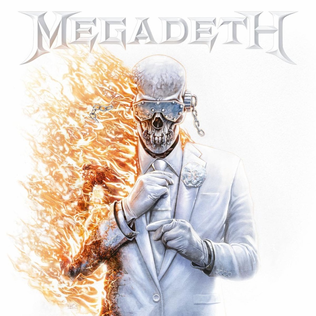
Megadeth Counts Down to Their Extinction
Megadeth (2026) Album Review
In the unforgettably quirky music video for “Sweating Bullets,” Megadeth frontman Dave Mustaine looks at himself in the mirror in an impossibly blue prison cell. While one might expect the reflection in the mirror to slowly become a source of antagonism with the self, the horror comes from beyond the frame ‒ an identical Dave Mustaine reaches out from behind and proclaims: “Hello me, meet the real me!”
One wonders if, after announcing retirement and a final album named after his band itself, the now older Dave Mustaine casually spends his days looking at himself in the mirror, thinking about his legacy in one of the world’s most successful thrash metal bands.
Whatever the original intent was, Megadeth became more and more about Dave Mustaine’s image as the years went along. At this point, he is even more of a band mascot than the skeleton that graces their album covers, Vic Rattlehead. After infinite lineup changes, the fierce redhead with the Flying V guitar persisted as the mastermind behind the project.
But Mustaine is more than a virtuoso of the electric guitar. He has also been reframed as a sort of internet meme. The extravagant and showy nature of Megadeth’s songwriting has inspired posts like “Megadeth be like: ‘I hate the government’ 18 solos,” while the delivery of “Watch him become a gooood” in “Symphony of Destruction” is inevitably the most memeable line in all metal.
Yet, perhaps the most important subtext surrounding Megadeth is the shadow of Metallica, which Mustaine used to be a member of over 40 years ago until his firing. And that is perhaps what challenges notions about Mustaine’s own self-awareness, given his refusal to let go of his rivalry with Metallica. Every now and then, he feels the need to say something about it in interviews, such as, “We’re still trying to improve our relationship,” which sounds more like couples therapy than band drama.
Thus, it is either hilariously tone-deaf that Megadeth’s last ever album ends with a cover of Metallica’s “Ride the Lightning,” or it’s secretly an essential part of the puzzle in crafting a complex portrait of Megadeth ‒ which also happens to be the title of their swan song.
Admittedly, Megadeth feels underwhelming on the first spin. For better or for worse, every Megadeth album has a stand-out identity, a particular sound or a tone. While a good portion of their discography is haunted by the technical complexity of the universally loved Rust in Peace, the individual albums still offer unique experiences in and of themselves, whether it’s the furious speed of Killing is My Business, the mid-tempo groove of Youthanasia, or the alt-rock crisis of the much-maligned Risk.
At first, self-titled comes off as more of a compilation of songs than a cohesive album, which is a fair skepticism to have in the age of streaming, where making albums has become less of a necessity when the digital distribution of singles is enough for online consumption. However, after perhaps my third listen, it became clear what the album was going for.
Starting off with possibly the most structurally ambitious song, “Tipping Point,” the album peaks too early. The sheer speed the song picks up to later trade for crushing, heavy riffs is likely to resonate with old-school thrashers. Though once we get to the next song, “I Don’t Care,” the mood changes bizarrely from a showcase of technicality and tightness for a looser punk-rock-influenced sound that wastes no time.
“I Don’t Care” is definitely the ‘meme’ song of the album, thanks to the bafflingly juvenile anarchy of its lyrics that go, “I don’t care and I won’t obey!” Whether Mustaine is being cheeky with the attitude is a mystery, but one thing is certain: it is not really far off from the Mustaine brand of defiance and refusal to comply.
We love Uncle Dave because of his lack of filter and unwillingness to hold back for better or worse. Perhaps when he was a punk rocker as a young man repping a Dead Kennedys Nazi Punks Fuck Off t-shirt, he had something concrete to be mad about. He is angry again in “I Don’t Care,” but this time it just comes off as an unmotivated statement that nonetheless feels like something Dave Mustaine would do without a hint of irony.
The concept of persona reveals quite a bit about the identity of this album. Perhaps to earn its status as the self-titled album, it tries to justify the Megadeth title by showing the different sides of the band. While the band’s roots are in thrash metal and they have been more or less consistent with the style since their *checks notes* third return-to-thrash album Dystopia in 2016, they have taken many detours in their history, delving into mid-tempo heavy metal territory following 1992’s Countdown to Extinction.
One of the most common criticisms against Megadeth is that it is more of a heavy metal album than a thrash metal one. While Tipping Point, Let There Be Shred and Made to Kill are definitely worthy representations of the band’s fiercer, faster side with a commitment to headbang-worthy riffs and solos, there indeed are quite a few recognizable mid-tempo detours in the rest of the album.
Songs like “Hey, God?,” “Puppet Parade,” and “Obey the Call” settle for groovier rhythms and more melodic sections. While it might be understood as a cop-out by those whose exposure to the band is through RIP, people who are familiar with the sound they captured from Countdown to Cryptic Writings will not be too offended by these songs. In fact, it clarifies the album’s intentions in creating a multi-layered portrait of the band by going back to revisit their sounds in different eras of their evolution.
Probably the closest-sounding album to this is 2004’s The System Has Failed, where they try to balance the more radio-friendly sound of their 90s material with the reintroduced thrash riffs.
“Puppet Parade”’s catchy riff especially echoes “Trust” from 1997, complete with a sing-along chorus. The “catchy” phrase can be used to describe many of these tracks. While Dave Mustaine’s voice is not in its full unhinged powers after his battle with throat cancer, his snarl is recognizable enough to sell the choruses on the songs, which can be as simple as saying the title of the song, like in the moody “Another Bad Day.”
Indeed, Dave Mustaine’s own health may be a factor in how these songs turned out the way they are. One of the reasons stated for the band’s retirement was Mustaine dealing with Dupuytren’s contracture in his hands, which makes it harder for him to play the guitar, especially on tour. Though his solos are still proficient, complex, and occasionally tricky in their speed, one can’t help but speculate if slowing down in new songs would make it easier to premiere them live.
Nevertheless, he certainly is in good company among his most recent bandmates, whose talents this album feels like a tribute to. Drummer Dirk Verbeuren has been behind the kit for a while, and he is allowed to show off in the outro for “Shred” and the intro for “Made to Kill.” James LoMenzo continues to fill in on bass with his own recognizable metallic tone.
The latest addition to the band is guitarist Teemu Mantysaari, who replaced the much-loved Kiko Loureiro from the last three albums. Mantysaari brings a soloing style that is already fluent and technical from his time in the power metal band Wintersun, which he modulates for the Megadeth sound ‒ and fits it like a glove. There is not enough “I hate the government” in this album, but there is an overabundance of solos in “Shred,” and it’s thrilling to hear Teemu and Dave play like brothers.
The sombre, slower tempo also makes Megadeth feel like a funeral hymn. The album “officially” closes with “The Last Note,” an emotional farewell from Mustaine about an artist who asks the listener to keep the legacy alive by never letting “this last note” die. Mustaine, who claimed to not care a few songs ago, lets down his guard for a while and shows that he indeed does worry deep down about his legacy and the fans as he breaks into a very pleasant acoustic solo in the bridge.
This rare moment of vulnerability is undercut by the harmonizing guitars that open the bonus track, which is Metallica’s “Ride the Lightning,” now covered by the man who claims to have written it in the first place. (What are they gonna say next, Mustaine wrote everything in “Kill ‘em All”?)
Whether you think this is disingenuous or not, you have to give in that Dave’s gotta Dave and that there is something so fascinating in his arrogance in refusing to let go of the past ‒ and thus, subsequently refusing to let go of who he is and who he became.
Dave Mustaine contains multitudes. Therefore, so does Megadeth. Megadeth is Megadeth ‒ for all its accomplishments and flaws.