Chloé’s Fraudulent TIFF Roundup
After three years of attending TIFF as an under-25 member and volunteer (in other words, a seasoned but struggling commoner), I had the non-negligible advantage of being granted a press pass to cover this year’s edition of the festival for The Innis Herald. With my only credentials being that I took an optional film studies class for two years in high school, was accepted into the NYU Film & TV program, and — like the People’s Choice ad expresses so justly — magically become a critic for 11 days, I hereby present to you:
☆ Chloé’s Fraudulent TIFF Roundup ☆
Of the 15 I watched at the fest, please find below reviews of three films that stayed with me long enough to muster up a few semi-interesting thoughts about.
La Gradiva (dir. Marine Atlan)
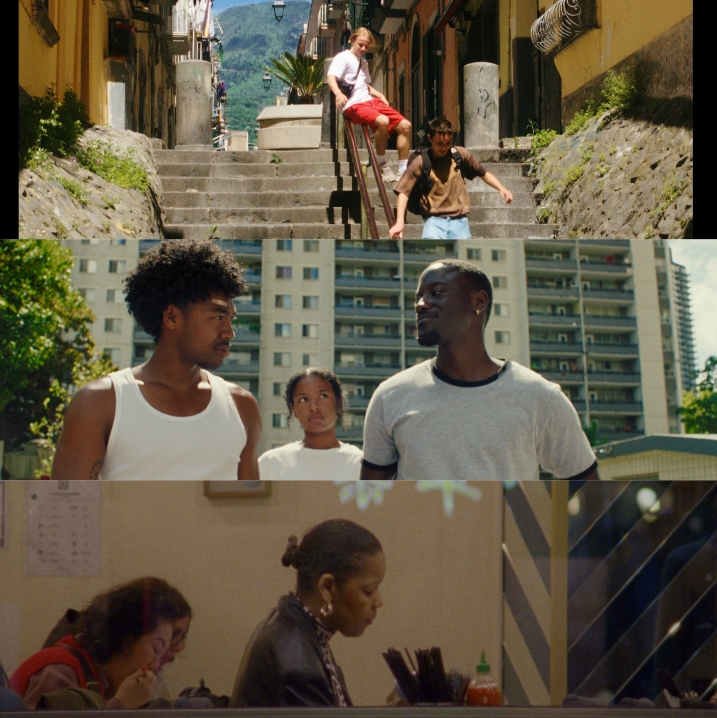
On a train to Italy, Suzanne watches Tony, who watches James and a classmate have sex in a private car. She silently listens in as the girls she’s rooming with talk of boys and attraction. She answers her teacher’s interrogations softly and stares at James’ hypnotizing face. In guarded looks and sullen expressions, she detects tensions that no one else seems to. Only once does she explode, when the class visits the Villa of the Mysteries, frustrated by the others’ noise while Madame Mercier is simply trying to do her job.
Suzanne is the empathetic nerd, Tony is the problem student, and James is the beautiful boy. Stated like this, it might seem as though Marine Atlan’s debut feature falls into cliché. Such was my initial fear walking into the theatre on the first day of the festival, after watching clips of the director talking about how she wanted to represent various high school archetypes. This fear quickly dissolved, however, upon the immediate sense of realness and complexity which surfaced in the snippets of expository conversation shared between the teenagers on their way to Naples.
Walking out, I was hit by the brief worry that the TIFF crowd might not be as receptive to the film as Cannes audiences were. La Gradiva is, after all, despite its location, unmistakably French. The students discuss how the country’s education system is failing its youth and why strikes are thus so prevalent — an incredibly relevant conversation, as the blockade movement which has been escalating since mid-September indicates. The reference to a dedicated humanities class, known as Humanités, Littérature et Philosophie or ‘HLP,’ is a feature proper to the French high school program, and the first mention of the Lycée Lakanal jolts me upright in my seat (my sister and I studied there for two years before our family moved to Toronto).
Walking out, then, I knew I had fallen instantly in love with the film. Yet part of me couldn’t help but wonder if that love came simply from the feeling of recognition I felt watching it, and a deeply personal nostalgia for my home country after being gone for so long. Upon reflection, though, it became clear to me that despite its specificities, the film manages universal resonance through a very evident, yet often missing element in cinema: a pure, uncomplicated understanding of what it means to be human.
Atlan films her subjects with the utmost care, whether they be her primary trio of students, the rest of the class, Madame Mercier, or even the various locals who populate the urban settings. In one short and devastating scene, the bus driver who navigates traffic as he brings the class to their museum trip asks the teacher if she’s ‘alone.’ Thinking he means to ask about her personal life, she confirms so with a somber look. He corrects her, saying he meant about whether she’s the only chaperone; the haunted expression she disguises with a smile lingers in the viewer’s mind into the next scenes, where her motherly instincts towards her students become all the more apparent.
La Gradiva brings the viewer an Italian heat in all its saturated splendour and unhurried charm, even as the rising disconnect between its main characters reaches its climax. Atlan proves with her debut feature that you don’t need intense confrontations or an explicit rupture to reveal the cracks that exist within and between us. Sometimes — and, maybe, most of the time — all you need is the subtlest of expressions, the shortest of phrases, and the most common of concerns to shatter your audience completely. La Gradiva adores today’s youth and allows them to speak freely, to dream and hope without judgment, to love; just that, on its own, is nothing short of an accomplishment.
Sunburn (dir. Serville Poblete)
At UC Library, where I’m currently investigating the background of seven posters we’ve recently put up on the mezzanine floor, I stumbled upon a use of the phrase “the peaceable kingdom,” on one such poster. Originally a Biblical verse and later represented by artist Edward Hicks in a series of paintings, the expression was taken up by literary critic Northrop Frye to define what makes Canadian literature Canadian. Frye contends that what characterizes Can Lit is a strain toward reaching this “peaceable kingdom,” a world in which man and man, as well as man and nature, are able to live in complete harmony. I am reminded of how, during my first Can Lit lecture, our professor asked a similar question: what did we think were the defining features of Canadian literature… if any?
TIFF has a history of dedicating a portion of their programming to Canadian cinema. This is unsurprising, given that the organization is largely government-funded, and the festival prides itself on being a major platform for Canadian voices and the country’s film industry. Looking at the fest’s archives held at the Film Reference Library, however, it becomes clear that there is not one trait unique to Canadian cinema compared to other national cinemas. Programme books, especially those of TIFF’s first decades, focus on the proliferation of Canadian films as a positive auspice for the industry, but rarely attempt to find common threads between the films it chooses to screen. This is perhaps a sign of humility on the programmers’ part, given that the question of a proper Canadian artistic touch remains, to this day, unresolved.
Set in an unnamed neighborhood in the GTA, Serville Poblete’s Sunburn follows a group of tweens and teens endeavouring to distract themselves on a scorching summer day after the power has gone out. Poblete’s debut feature doesn’t need to insist on its Canadianness — or, more accurately, its Torontonianness. Instead, it lets it exist uncomplicatedly, through brief flashes of everyday life on the outskirts of the city: in friends discussing the best food spots around; in the hint of the CN tower standing proudly in the distant horizon; in all the kids of the neighborhood rushing at once, summoned by the familiar jingle of the ice cream truck.
When asked about their hopes for Canadian cinema during the post-screening Q&A, Poblete and the cast expressed their desire to see more stories of marginalized groups told on the big screen, before suggesting that Sunburn is one that can be understood from any part of the world. Indeed, the film goes much beyond a national or local character. Unexpected camera movements (at one point, the audience briefly enters the perspective of a fly!) and unconventional close-ups create a distinctive visual universe, revealing the director’s intention in the making of this film. For the close shots, Poblete explains that he wants to place emphasis on black and brown bodies — ones often forgotten in cinema — and subvert the usual assumption that such shots are necessarily sensual in nature.
Personally, my favourite shot of the film is one that I feel encapsulates its vision as a whole. As two friends converse, sitting on the edge of a sidewalk, the camera zooms in on the sight of the melting popsicle one of them is holding, which drips onto the pavement. Engrossed in their discussion, neither seems to notice. Time ticks by until the popsicle has fully succumbed to the heat, but it is of no matter: the real treat lies in the easy companionship of your most intimate friends.
At Night (dir. Beatrice Gibson)
One of my most anticipated films of the festival, At Night is an ode to the invisible workers, moonlight flâneurs, and other night owls who compose the often quiet, always lively visage of the City of Lights past sundown. The film opens with a woman on the subway listening to a voicemail; later, two strangers strike up a conversation on a train platform, delighted to realize they share a mother tongue. Subways are but one of the many points of convergence that punctuate Paris at night, where the webs connecting late-hour roamers of the city are weaved. A restaurant, a bus stop, or a corner store are just some of these illuminated spots where people — women, as this film is centred around — meet, debate, and comfort one another in brief flashes of respite.
Growing up with something resembling a curfew, I have rarely had the chance to see cities at night — whether it be my metropolis of birth, Paris, or of adoption, Toronto. During the festival this year, I’ve gone home rather late many times after my final screening of the day, and one thing I noticed was how different the city looks at night. Though I resided within walking distance of King St. (thanks to a dear friend who kindly hosted me for a few nights — shoutout Z!), I often found myself disoriented, using the most recognizable buildings and features of the road to map out where I was. One shot from At Night sticks to my mind in particular, even weeks later: the end of an empty street, disappearing into darkness, flanked by sidewalks on each side and a neon splash of light above of what might have been a store sign (I can’t fully remember, now). It’s the kind of view you’d find in any street of any city after dark, and the memory of it fills me with hollow warmth, like a long-awaited homecoming.
The film moves at a slow pace and without a central narrative or story, as we jump from one woman, or group of women, to another, in smoothly orchestrated succession. The heart of it lies in the intellectual yet mostly cheerful conversations held between its characters. Its best example may be the one selected as a promotional teaser, where a group of female artists and friends sitting at a round table discuss sex, pregnancy, motherhood, and feminism, chiming in spontaneously to form a happy cacophony of feminine voices. When one speaker’s words resonate, however, she is never the one shown on screen. Almost without fail, Gibson shows us the faces of her interlocutors instead — their agreement, laughter, and shock, in this moment of shared experiences and commiserations, integrates the viewer into the film by showing us exactly what each of these women see.
Along with lingering shots of the city and fragmented storytelling, such discussions, verging on improvisation, contribute to creating a film that feels more like a documentary than a readily prepared script. While it doesn’t seek to engage too deeply with the myriad of topics brought up — from the realities of womanhood to racial and class divides — Gibson’s debut feature is far from an incomplete work. The audience, dropped into the overlapping personal stories of its various characters, perceives both Paris in the shadows and the shrouded tragedies unfolding behind the silhouettes of the women it follows, witnessing, in all its possible meanings, what life is like at night.
Images: courtesy of TIFF