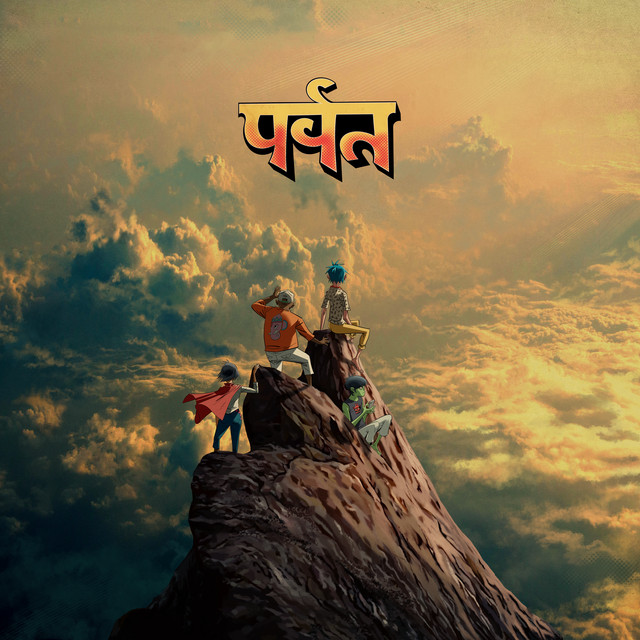
Gorillaz Transcends Existence & Afterlife Through an Emotional Journey Up & Down The Mountain
Amidst the impending chaos on earth, Damon Albarn & Co. channel life, loss, and liberty into a musical meditation on grief, mending our suffering with cultural harmony.
✬✬✬✬✬
What is The Mountain? In 2024, Damon Albarn, one-half of the virtual band Gorillaz, lost his father. Less than two weeks later, Jamie Howlett, the adjacent half, suffered the same loss. Grief-stricken and artistically stagnant, the duo left England, embarking on a cross-continental journey to the only place that could nurture both soul and sound: India. What emerged from this transformative expedition across the streets and vistas of Varanasi, Jaipur, Rishikesh, Mumbai, and New Delhi became the core rocks of culture, buried deep in the emotional layers of sediment that comprise The Mountain.
↑ The Mountain, The Moon Cave & The Happy Dictator
And then there was sound. First, we hear breaths of a bansuri from flutist Ajay Prasanna, plucked strings of the sitar from Anoushka Shankar, and sarod improvisations from the Bangash brothers. Mixing classical Hindustani elements with the multi-layered voices of deceased Gorillaz collaborator Dennis Hopper, the opening title track immediately sets its sonic-spiritual ambitions loose: “All good souls come to rest.” From here, Gorillaz begins the ascent up The Mountain from the very bottom, deep beneath the earth in “The Moon Cave.”
Awakening, 70s fusion artist Asha Putheli and R&B legend Bobby Womack provide harmonies over angelic, orchestral strings alongside disco-inspired synth palettes, while Albarn’s bereaved lyrics portray a transition from life to death that commences within the dark confines of the cave. Hindu philosophy — stripping the ego from the soul — further initiates the departure from the mortal world: “You must wash all your perfume from your body.”
After shifting grooves to a hip-hop-coded Black Thought verse between both soul singer Jaden Ngonda and De La Soul member Trugoy the Dove’s adlibs, “The Moon Cave” then rises to “The Happy Dictator,” where pop-rock duo Sparks provides sharp satiric commentary on the absurdities of political propaganda and detached leaders. As the ironically upbeat, 80s-inspired digital rhythms fade, the pain then centers back into view.
↑ The Hardest Thing / Orange County
From the grave, Africa 70s drummer Tony Allen provides a meditation in Yoruba on the interlude, “The Hardest Thing,” as Albarn’s heartbroken sentiments lay the melancholic tone that will bleed into the following “Orange County.”
The emotional centerpiece of The Mountain, “Orange County” blends Mexican trap brass from Argentine producer Bizzarap with indie artist Kara Jackson’s gentle vocals to juxtapose Albarn’s reluctance to continue climbing amidst the emotional toll of his suffering: “I don’t know if I can take this anymore, so why are you trying to break me?” Interweaving Shankar’s sitar with a whistle melody that is as catchy as it is tearful, “Orange County” — in the same musical vein as “On Melancholy Hill” — serves as fleeting goodbye to a lover, father, friend, or family member.
↑ The God of Lying, The Empty Dream Machine & The Manifesto
Naturally, this reluctance persists in the existentialism that is “The God of Lying,” where contemporary post-punk lyrics from the Idles criticize the ongoing epidemic of misinformation plaguing the digital age. Repeating, “hope is behind, and I wanna get high,” Gorillaz fuses psych-reggae experimentations with falsetto vocals to portray the dark and nihilistic decay of society — led not by beings, but 6-inch screens.
In a similar existentialist light, “The Empty Dream Machine” further slows the tempo to reflect the harrowing, hopeless sentiment of Albarn as he plaintively navigates both personal loss and pensive depression over the deteriorating state of civilization. Gradually building with The Smiths’ guitarist Johnny Marr, a second Black Thought verse, and Shankar’s sitar embellishments, “The Empty Dream Machine” concludes in a desolate plea for solace amidst the impending chaos, a cry before the incoming high at the top.
With “The Manifesto,” the band reaches this high on the bright summit of The Mountain. A sonic odyssey of production and language, the first half of the track features Argentine rapper Trueno laying a Spanish verse over Indian tabla drums and choir chants. As the melody fades, the production disperses into a cacophony of brass from the Jaipur Jea Band, accompanying a posthumous freestyle by D12 member Proof. Building in tempo, “The Manifesto” climaxes in its fusion with the first half, as Trueno returns with an aggressive second verse before dissolving into a dreamy, synth-coded outro under hypnotizing lyrics from Albarn. Taking in the views that lay atop, Gorillaz must now begin their descent down The Mountain to fully complete the journey. “Only automatic now.”
↓ The Plastic Guru, Delirium, & Damascus
Trekking downwards, the band encounters “The Plastic Guru,” a critique against the faux nature of authority figures desperate for power and profit. Combining choir harmonies, sitar, electronic-piano backing, digitized Lou Reed vocal excerpts, and diegetic Indian city street ambience, Gorillaz portrays an ironically vivid picture of a corruption polluting religious gurus, presidential candidates, and social-media influencers alike.
The commentary continues in “Delirium,” an electro-funk anthem that infuses The Fall frontman Mark E. Smith’s eclectically abstract vocals with wonky disco synths, screaming choir refrains, and punchy drum kicks to invoke the lyrical chaos of authority gone mad. “Open the door / raise the alarm” — Albarn’s messaging serves as a danceable cautionary tale against civilizations entrusting the delusional with absolute power.
Delving deeper, “Damascus” maintains the up-tempo streak with a call-and-response between 90’s conscious rapper Mos Def and Syrian Dabke singer Omar Souleyman. Bouncing between English and Arabic, the track incorporates ancient Middle Eastern woodwinds — such as the mijwiz — alongside hip-hop drum machine samples to underscore its themes of the refugee ship-to-sea experience across coasts.
↓ The Shadowy Light, Casablanca & The Sweet Prince
Nearing the bottom, “The Shadowy Light” marks a breakthrough in Albarn’s grieving process. Featuring vocal passages by renowned Hindi cinema playback singer Asha Bhosle and Welsh musician Gruff Rhys, the title and chorus of the song suggest a different way of interpreting death: moksha — a Hindu belief that sees physical passing not solely as pain and loss, but also as spiritual transcendence — an attainment of eternal liberation. Death as both beauty and suffering — an oxymoron that directly encapsulates “The Shadowy Light” — reverberates through the omnipresent choir, bansuri, and sarod accompaniment.
The following “Casablanca,” enlisting The Clash’s bassist Paul Simonon as vocal backing for Albarn’s somber lyrics, returns to the melancholy of the initial ascent up The Mountain: “And the inmates’ cells / always remain open / as they stare into the abyss.” Sung above the ballad-inspired string and keyboard work, the constraints holding humanity back from liberation become a matter of mind; we are our own worst enemies, enclosing our respective worlds from touching one another.
With the floor now in sight, Albarn makes one last detour on “The Sweet Prince.” Finally facing the moment of his father’s passing, Damon comes full circle on the journey to understanding ‘the end’ — or at least what this ‘end’ may entail: “Sweet prince, don’t be sad / You were never meant to be here / And the sword you hold in your hand / Well, its mighty blow will set you on / Your patterned path into the next life.” Channeling his father’s passing into an optimistic reincarnation of soul and body, “The Sweet Prince” finally heals our wounds; serene ocean waves and distant harp strings, alas, bring peace.
↓ The Sad God
Touching ground, Albarn & Co. return to the mortal world. Transformed by the excursion across life, loss, and time, “The Sad God” becomes the final comedown of a beautiful high. Detailing the disappointment of a deity distraught by the malpractices of humanity, The Mountain closes on a somber, yet calm moment of acceptance regarding the futility of the human condition to learn: “I gave you atoms, you built a bomb.”
This ignorance of the damages made in our wake becomes a premonition of abandonment: “Now there is nothing, and I have gone / No more mountains, no more song.” A culmination of the journey, featuring Albarn’s passive vocals, Prasanna’s bansuri, Black Thought’s final verse, and Shankari’s expressive sitar, the track releases a mirage of melancholy in each passing line: “No more prayers sent up into space / only screens left to see your face.” Climaxing in a harmonious instrumental outro comprised of the ever-present Hindustani classical instruments, alongside digitized chords and children chanting in the distance, The Mountain closes with one last impression, an invocation for the heart of the human race to propel: “I gave you garlands / You closed your eyes / In paradise.” In the end, all that is left is the solitary sobs of the bansuri, gently dimming back into oblivion. Transcended, we return, reconciled and ready, for the sweet, sweet silence.