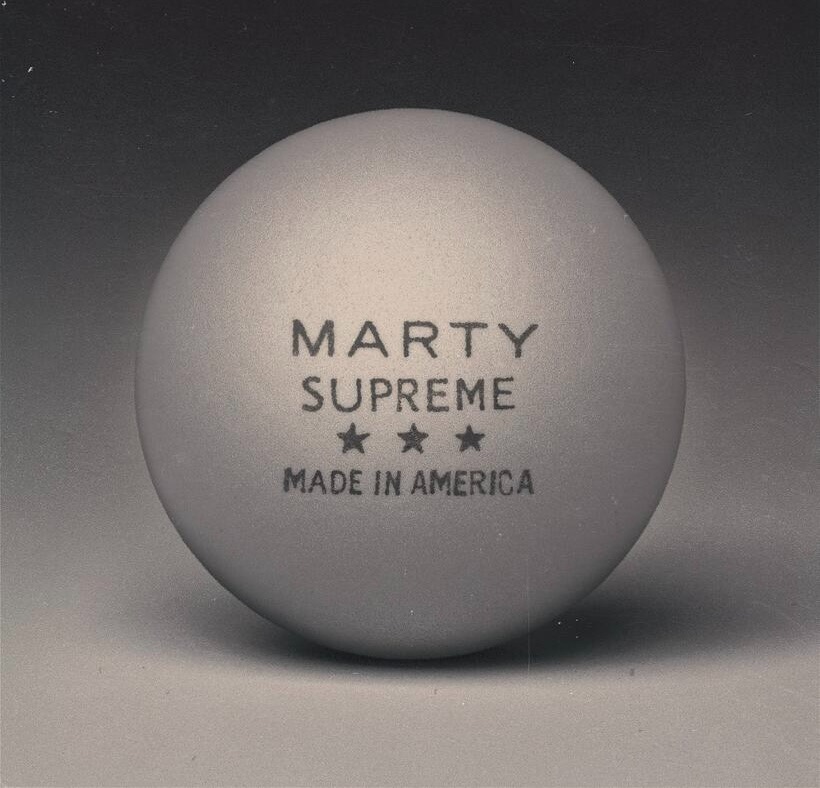
Josh Safdie Dreams Big and Loves Greater with MARTY SUPREME
Defying the American Dream, the writer-director’s ambitious sports drama blossoms into a coming-of-age love letter to youth.
★ ★ ★ ★ ★
“Let’s dance in style, let’s dance for a while.”
“Marty Mauser, a young man with a dream no one respects, goes to hell and back in pursuit of greatness.” Following a split with longtime collaborator Benny Safdie, director Josh Safdie’s solo debut has just as much to prove as his film’s ping-pong playing, aspiringly abrasive yet charismatic protagonist. The main questions on every fan’s mind leading up to this release: which Safdie has it? Who exactly is the mastermind behind the modern-day classics of Good Time (2017) and Uncut Gems (2019)? Even more relevant: does Marty Supreme (2025) live up to the hype of its bombastic marketing campaign? The answer is just as subjective, and complicated, as Mauser himself. What is certain is that Marty Supreme commits to a style, a dance, an idea, so relentless in nature that, whether the ball lands on the table or not, one cannot help but cast their gaze upon the bold swing of its ambition.
“Praising our leaders, we’re getting in tune. The music’s played by the madmen.”
Under a system governed by order, conformity, and dispassionate thinking, art becomes the key outlet for individual expression. Anachronism, in particular — an intentional deviation from historical accuracy — forms the crux of Marty Supreme. From the incorporation of Alphaville’s “Forever Young” during the opening credits’ conception sequence to the closing Tears for Fears’ “Everybody Wants To Rule The World” needle drop, Safdie coats a film set in a gritty 1950s with 80s pop nostalgia — classics and deep cuts alike. His longtime collaborator, Daniel Lopatin (in the EDM sphere known as Oneohtrix Point Never), builds on these aesthetic choices with an original score that wholeheartedly evokes the 1980s through synth-infused genre elements of electronica, new wave, and city pop. On “The Apple,” pan flutes and choral passages sonically capture an aged starlet who ignites Mauser’s human impulses, whereas tracks such as “Endo’s Game,” “I Love You Tokyo,” and “The Real Game” use allegro synth-bass backing to embellish the urgency of his sports vision, a quest equally enthralling as it is niche. Marty’s dialect itself — a mixture of modern slang and outdated terminology — only further blurs the line between an archetypal period piece and postmodern sentiment. The entire audio-verbal projection of Marty’s spirit is thus rendered out of tune, unconventional, yet crystally-radiant from the world around him. His soul, alive and alien, appears as a shining vision of tomorrow, trapped in yesterday, pleading with every last expression to reach his dreams of the future.
“It’s so hard to get old without a cause. I don’t want to perish like a fleeting horse.”
In the months preceding Marty Supreme’s Christmas debut, no one has done more for the film’s pop culture takeover than its own frontman. Timothée Chalamet is far from a traditional movie star. Following his rise to Hollywood leading-man status, the 30-year-old actor has, alas, been given the opportunity to fully flex his digitally fluent nature as a marketing savant. From attending fashion-forward Marty Supreme-labelled merch drops and transforming the Las Vegas Sphere into a giant ping-pong ball, to bombastic in-character interview junkets, orange-branded blimp popups, WWE analysis, celebrity endorsements, Wheaties-box collaborations, and even an EssDeeKid feature — Chalamet’s guerilla-style social media crusade is as audacious and self-mythologizing as his character. There is a meta quality to the interplay between Mauser’s athletic aspirations and Chalamet’s prophetic self-promotion that extends to the film’s external inhabitants. Marty’s spiritual opposition, a senior cutthroat business magnate, Milton Rockwell, is portrayed by none other than Shark Tank media mogul, Kevin O’Leary. Meanwhile, Rockwell’s washed-up, Hollywood film star-turned-trophy wife, Kay Stone, seductively manipulates Mauser through a return-to-form performance from the industry-abandoned actress herself, Gwyneth Paltrow. The mirroring of Marty Supreme’s character ensemble by its cast only further embellishes the fictional couple’s symbolic embodiment of sovereign cynicism. These figures of authority, egomaniacal and abundant with power, manifest as Marty’s spiritual antagonists, both in ideology and influence. Disheveled dreamers turned elder socialites, lost to archaic thinking over time, the duo form the core antithesis to Marty’s youthful vitality. Equally corrupt as they are pragmatic, Rockwell and Stone — mere silhouettes of once glistening spirits, shattered by the gradual desecration of soul — are the gatekeepers to the forgotten dreams of adolescence. Dreams desperately championed, hand-in-hand, by Chalamet and Mauser, from forever fading into obscurity.
“So many dreams swinging out of the blue. We’ll let them come true.”
Any filmmaker, artist, or auteur, protects an idea, vision, or dream, of what they want their film to be. The larger the scale of its production, the likelier the director is to face pushback from the studio, financiers, and audience for their authentically unique perspective. The result of this conflict is often a compromise, typically at the expense of the dream. Much has been said about the criticism regarding the ‘uncomfortable,’ possibly sociopathic actions and values of Marty Supreme’s titular character. While criticism is a valid and intrinsically vital component of media, it is where these criticisms derive from, and not the critiques themselves, that often demonstrate fallacy. Personally, I subscribe to the notion that art inherently is not, and does not have to function as, a ‘how to life’ manual for viewers. While films are inherently reflective of the place, period, or moment in cultural thinking they are conceived in, they do not seek to tell their stories for the vain objective of socially accepted ideological espousal, but rather to explore exciting — even if controversial — fictional scenarios rooted in our complex world. This balancing act between upheaval and subversion to the audience’s reality is what keeps them invested to the very end. Only in retrospect can one recognize that an engaging story felt exciting, yet ‘natural.’ The insufficient masquerade of binary morals that some choose to project onto fictional protagonists is more indicative of their own worldview rather than the supposed ideals of the film itself. The same lack of depth that some often fault characters for, they fail to apply to both their reviews and their own blaring, self-serving moral philosophies. I do not have to align with nor glorify the sins of the flawed or even evil protagonist in order to emotionally invest in their dreams. One can still be compelled by the journey, so long as its vessel contains some element of nuance. The grand vision of Marty Supreme — for better or worse — is anything but rudimentary. At least for once, the vision has actually reached us.
“Forever young, I want to be forever young.”
Marty Mauser is, through and through, an asshole. Maybe the exact antithesis to the long-needed, male ideal of modern American progressivism, or maybe just a traditional antihero. He recklessly robs, manipulates, and lies his way to the very ‘top’— at least, what can be described as the top of the undermined world that is competitive table tennis, constantly using his own ascension up the ranks of the system to justify his breakage of it. Marty is a hustler, with all the ambitiously abnormal charm and emotionally detached callousness that comes with it. But he is also a baby fish in a world of sharks, too obtuse and inexperienced to internalize the damage caused by his actions. It is easy to paint this ignorance in the same light as the often toxically worshipped protagonists of the ‘internet age’ (think American Psycho’s Patrick Bateman or The Wolf of Wall Street’s Jordan Belfort), but doing so invariably strips the character of their complexity, losing the vital nuance that accompanies humanity. Marty, despite his ‘success,’ does not have the privilege of impunity attached to the aforementioned capitalist archetypes. He is an iconoclastic, physically frail, inner-city Jewish boy who chases escape amidst a post-WW2 empire that preys on the dreams of youth. Antisemitism and poverty are mere footnotes in the cascade of setbacks that Uncle Sam imposes on the adolescent backbone of American society. Adhering to his status as an underdog, Marty’s careless behavior does not go without consequence; the powerless will always be punished for their wrongdoings. Humiliation and severance are just as catastrophic to his journey as the narcissism and victory that precede it. There is a distinct absence of glory for Marty in the third act of this sports drama that distinguishes his story from genre convention. He does not get his ‘big break’ nor a simple congratulations. Externally, Marty ends just as he begins: a nobody. Just another adolescent having pursued an idea that cannot, and could never, survive. It is this pursuit in the face of futility — a desperate, uncompromising attempt to hold onto the hope of youth, that the aged, long-neglected part of ourselves admires.
“Do you really want to live forever?”
Where Safdie’s past iterations of the maniacally-obsessive, self-destructive yet compelling protagonist ultimately conclude in complete annihilation (Connie’s arrest in Good Time, Howie’s demise in Uncut Gems), what’s presented here is a development, or reinvention, of the anxiety-riddled, stylistic cautionary tale: a second chance. Marty, having reached some semblance of his dream — despite his abolishment from the competitive world — bids farewell to both his ignorance and this formative period of his life, having just for an instant, touched victory. Not for the adults, audiences, judges, or even Rockwell — their approval was never in the cards — but for himself. A small, fleeting moment of internal gratification for all the sins committed and suffering endured. What awaits is simultaneously moral penance and spiritual liberation for the grand dreamer. “You will never be happy,” Rockwell leaves Marty with after being played. No matter what one accomplishes, how much they are praised, or how far their success takes them, it will never be enough. Never can be. Never could have. Returning home, Marty knows the highs of validation cannot last forever. His youth mustn’t perish, but blossom into adulthood, for his spirit to remain whole. In realizing this, he can finally tune his vision towards the deeper, external joys of living, shared with others, to fulfill what lies within. Marty’s real success — the more important story — has yet to be made for himself. What, and who, awaits him amidst the chaotic remnants of relationships left in his absence, is where the dream finally becomes real.
Welcome to your life.