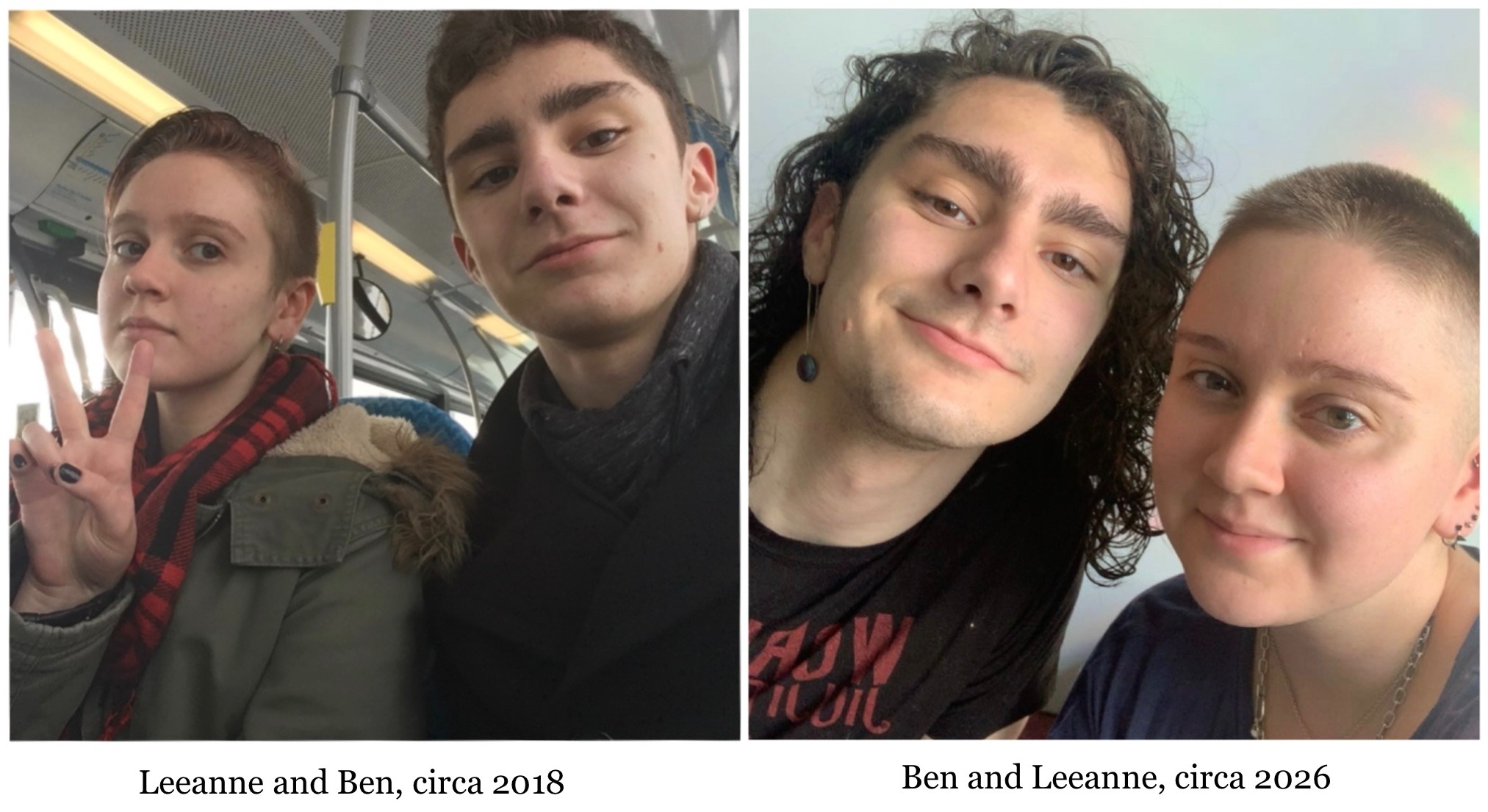
Reviewing a Decade-Long Friendship: Interview with Benjamin Thibodeau-Fillery
L.F.: How long have we known each other?
[pause]
L: Oh my God, you don’t know?
BEN: I didn’t know if you wanted the year or the number! Since grade 8. [Ben has never admitted that we met in eighth grade; they insist it was seventh. They have finally admitted the truth for the sake of journalistic integrity.] So, about nine years. Almost a decade.
L: Wow, I didn’t realise it’d been that long. How did we meet?
B: We went to the writer’s workshop together run by the librarian at my school, and afterwards, you sent me an email and said, “I like your bag,” and that’s how we started talking. And that was great because I really wanted to talk to you, but I was very nervous and scared, and that gave me an in.
INTERESTS
L: Do you think our friendship has influenced our shared interests, academic careers, and career aspirations?
B: Absolutely. I mean, I’ve always really wanted to be a teacher, but certainly having friends who want to be teachers—even if it’s for a different grade, with a different level of expertise—has by and large been what’s kept me in my program as long as it has. I absolutely would have either changed programs or dropped programs and done something else if I didn’t have that. In terms of shared interests, we kind of got started with a lot of the same interests to begin with, but my interest in literature and gaming and even movies has really developed as a result of or a reaction to your interests. Even for something like Fortnite, right? I wouldn’t have ever played Fortnite for longer than the average teenager plays Fortnite if you didn’t also think it was cool and then we got into it together.
L: It’s helped me having you introduce stuff that was almost in my ballpark, but slightly to the left.
B: It’s kept your comfort zone expanding.
L: Exactly. Like, one of the last things you lent me—Perfume [by Patrick Süskind]. I don’t think I would have found that without you recommending it.
B: Well, it’s so funny you mention that, because I would not have found it if some person with an interest in deeply disturbed fiction hadn’t recommended it to me. It’s the only book I remain relatively impressed by that he recommended to me.
L: What other ones did he recommend that didn’t sit right, if you remember?
B: There was one called—oh, fuck, what was it called? It’s not gonna come to me—it was about paedophilia and vampires.
L: Oh, goodness.
B: Yeah, not my wheelhouse.
ROMANCE
L: What role do you think, if any, our friendship has played in our respective romantic relationships?
B: Well, you know, I was dating [REDACTED] for five years. It was really four and a half, but it’s easier to round up to five because it sounds more dramatic. [. . .] I was very uninterested in hearing criticism. Not because the criticism wasn’t valid, but because I was very defensive about it and I felt that it wasn’t worth anyone else’s time. Then it took one conversation with you where you were like, “I don’t know if you’ve considered these things, but this is what it looks like to me.” And I was like, Oh, I’ve gotta break up with this guy now. [. . . ] And I think the same is true vice versa. I don’t want to overstate my influence . . .
L: No, for sure, it was helpful having you to talk to. So many of the people that I felt I should or could be going to for relationship help were people that were mutually involved [with both my ex and I]. So, they sort of felt like they had an obligation to play devil’s advocate in a way that you don’t, because you’re only looking out for one party primarily. And that’s all that I was asking you to do.
B: [. . .] A big part of friendship is being able to take your friend to task. Being able to say, “I love you and I’m looking out for you. This is what I need in order for this relationship to work,” or more importantly, “I can see that you’re struggling and I am worried.” Confronting your friends is something that I think seems very taboo nowadays, but that’s never been a big deal to me. It’s not always going to be sunny days, and I really hate the concept of fair weather friends. [ . . .] If you want a friendship to last—and you should—you want to put effort into it.
L: There’s no point in suffering through something you foresee ending soon.
B: That’s the thing—I am not the sufferer, okay? If it sucks, hit the brakes.
L: It’s a waste of time!
B: Yes! At the same time—look at me, holding two truths at the same time—a certain degree of suffering is necessary in order to have a mutually beneficial and cohesive relationship. It really does resonate with me, the idea that “to be part of a community is to be uncomfortable.” Like, a baby moved in next door. That bitch screams non-fucking-stop. And that’s through six inches of concrete. I don’t know how we’re hearing that. That baby has lungs fit to blow the horns at rapture; he will be ready. But, am I going to say anything? Fuck no, I’m not. They have a newborn baby.
APPRECIATION
L: What has been your favourite part of being friends with me? [pause] I know I’ve just asked the question, but looking at the embroidery you’ve done on your pants—you’ve got so many cool things on there—I want to say that one of the things I have really liked about being friends with you is seeing you take up so many different art mediums, trying out different hobbies, and fully getting into each one and excelling in them. You’ve done sewing, you’ve done embroidery, you made me a tote bag that I use every single week, you still write, you read a lot, you cook, you’re a fantastic baker . . .
B: I ate.
L: You did eat!
B: I will say, the thing that immediately pops into my head was that you have this kind of penchant for unconditional kindness. And the layman might say that this should just be the norm in friendships, but it’s not. It really, really isn’t. [. . .] Sometimes before I know it myself, you understand how to help and support me. And that is because you are attentive, and observant, and you place a lot of stock in making sure that it’s clear that you care.
L: I also think that you are very easy to care for. You make it easy to be attentive and observant.
B: I appreciate that. But, I don’t think you give yourself enough credit for how much light you bring to the world around you, and how much joy and peace kind of exists in a bubble around you. [. . .] You have this recognition that friendship is sometimes difficult. That friendship requires mutual support and you never shy away from that.
L: Because it’s always so worth it. It always has been.
B: I love you dude.
L: I love you! Thank you for letting me interview you.
B: Thank you for interviewing me!
L: Now I’ll be happy to take you to work, if you want.