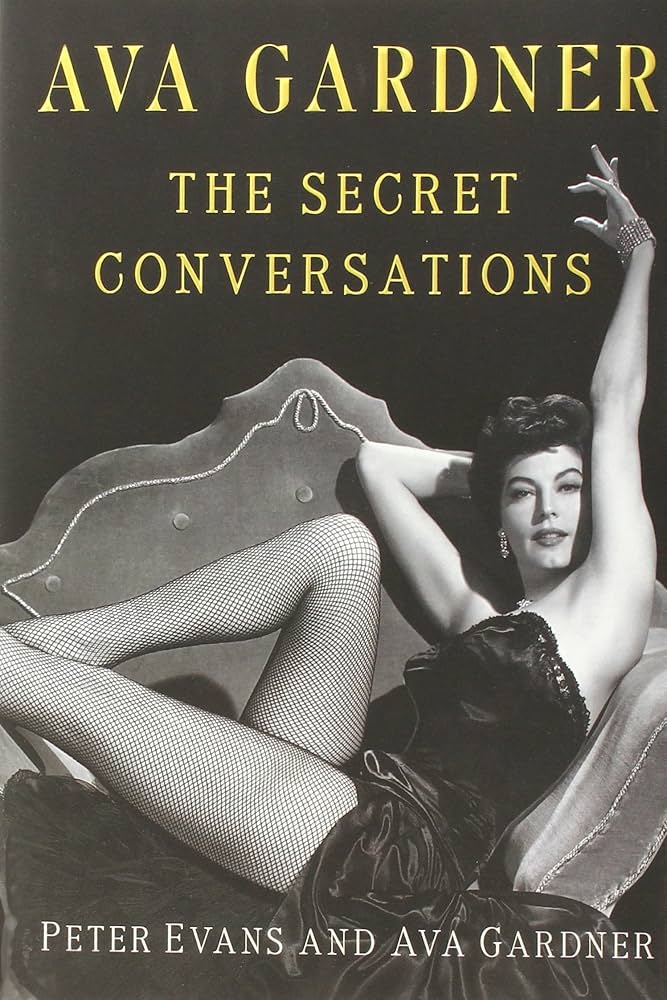
Ava: The Secret Conversations
Imagine my surprise when I stumbled upon a line of theatre-goers queued up for the stage adaptation of one of my favourite Hollywood autobiographies. Elizabeth McGovern, of Downton Abbey fame, has crafted a star vehicle for herself with Ava: The Secret Conversations, now making its Canadian debut at Mirvish’s CAA Theatre.
The play revisits the late 1980s meetings between Ava Gardner (McGovern) and journalist Peter Evans (Aaron Costa Ganis), enlisted to ghostwrite her memoir. Their collaboration imploded after she learned Frank Sinatra had once sued him for libel; decades later, the estate finally allowed him to publish their conversations, which would emerge as Ava Gardner: The Secret Conversations.
To me, the book reads as a delicate pas de deux between Gardner and Evans. Evans slips into the role of a confessor-therapist, listening and psychoanalyzing a once-mythic Hollywood lioness now erratically pacing through the ruins of her own legend. In their cat-and-mouse interviews, what begins as professional inquiry trembles into something more vulnerable, as Evans becomes quietly enamoured by the very subject he’s meant to dissect. Evans records Gardner’s advances and retreats, corroborations and contradictions, and slowly a fuller silhouette emerges. What’s left is an autobiography that refuses rigidity — not pedantic, not dishonest, but deeply alive.
But McGovern’s backseat steering never quite lands on the book’s delicate nuance. The luminescent Ava Gardner is rendered as a kind of chalk outline — all gesture, hollowed at the centre. The script attempts to impose structure by inserting three flashbacks, with Ganis slipping between Evans and Gardner’s three husbands, but the effect flattens the book’s wandering, lyrical pulse. The slow, intricate unfurling of Gardner and Evans’s friendship is pared down to primal desire. By the end, it becomes clear that the play isn’t truly about Gardner at all — it’s about the Gardner who flickered into being in Evans’s presence, and, perhaps even more so, the constellation of men who once orbited her. Her cinematic legacy receives only a cursory nod, glimpsed in a few projected images of Ava at press screenings with her ex-lover de jour.
McGovern’s performance hardly rises above the limitations of the script. The gestures, the shifting accents, the expressions meant to chart Gardner from ingénue to post-stroke fragility were pushed and inflated past their natural scale. The intuitive, magnetic Gardner of the page becomes, in her hands, oddly erratic: a figure bordering on the loonish. The tragedy is not in Gardner’s decline, but in how diminished and distorted she becomes on this stage.
Ganis also falters with the accents now and then, but the script gifts him far richer terrain to play in. Evans longing to write a respected novel instead of a trashy celebrity biography; Sinatra ducking the spotlight rather than basking in Gardner’s radiance. Each man carries his own set of stakes and private bruises, yet there’s a subtle resonance among them — a quiet kinship that Ganis teases out with ease. Watching that thread connect his characters becomes one of the production’s rare, genuine pleasures.
The play ultimately amounts to a series of shallow plunges into the buzziest headlines of Gardner’s life and career. I left the theatre disappointed; the projected images of Ava’s startling beauty and raw vitality only made me long to return to the book — and to her films. The production itself, however, leaves almost nothing else that lingers.