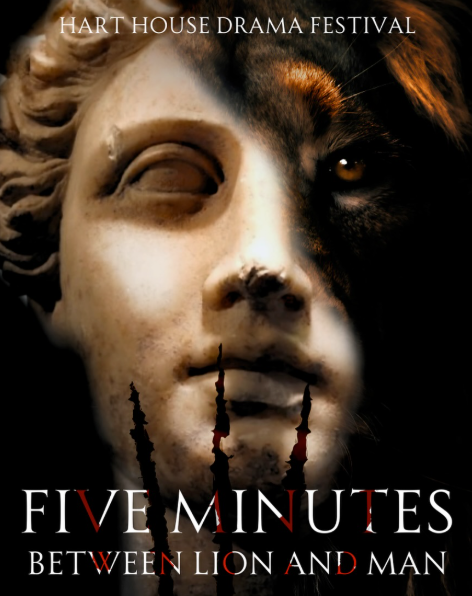
Exploring the Definers in Five Minutes Between Lion and Man
Warning: Please note that this article contains spoilers for those who have not watched Five Minutes Between Lion and Man.
Unfortunately, my dreams of becoming a star on the stage were shattered early in middle school when I realized that my acting skills were so devastatingly bad that I could not even trick my mother into letting me skip school by saying I was “dying from a stomachache.”
My passion for theatre did not remain an unrequited love, though. While I did not have the slimmest chance of becoming an actor, I’ve always been fascinated by others’ talents, and luckily for me, I’ve had wonderful opportunities to review countless theatre productions. Five Minutes Between Lion and Man, presented by Hart House Theatre, was one of them.
When I was first informed about the opportunity to write for this show, I was thrilled, especially after learning that this play was a Greek tragedy. Greek mythology is complex, as it involves grappling with emotionally intense themes. Yet they remain relevant to modern emotions, and sometimes even help us face the inevitable things that our eyes can see.
Five Minutes Between Lion and Man, written and directed by Avi Mangus, captured this essence marvelously, and I am confident it would strike a familiar emotion within many people as well.
After a chaotic night of wine-drinking at an exclusive rave, Agave stumbles out of the party, drunk and happy like she’s never been before. Playing Agave, Grace Elizabeth Huestis is a bubbly blast. Giggling uncontrollably with flailing arms as the drunken euphoria washes over her, she recounts the delightful night with blissful ignorance. Agave creates a violent fantasy in a frenzied state, convinced that she killed a lion that invaded and threatened the party. With crazed eyes, she smiles proudly, as if she had done a heroic deed.
Yet, Dionysus, played by Dalila Bejar-Ali, insists that she is obscuring the truth. Frustrated by Agave’s avoidance, she furrows her arched brows. Almost begging, Dionysus urges her to remember what she had done. Twisting and turning her long staff masterfully, she embodies a prominent Oracle who guides her to the truth.
But what does the truth matter when it isn’t the one you want? Confused, Agave begins to retrace the night from the beginning, attempting to detangle her memories. As she slowly pieces together what truly happened at the party, a piercingly painful clarity gushes to her – the “lion” that she ripped into pieces was actually her own long-neglected child, Pentheus. That night, Pentheus had been joyfully expressing their queer identity at the party, wearing their mother’s favorite dress.
Despite having seen tons of shows this past couple of years, I had never watched a two-hander performance before, and this one fascinated me. Each actor fiercely pushed and elevated the other in this emotionally intense story with such force. Every eye was on those two, and those two only; the dynamic of the entire performance hinged on the energy they generated together and built on each other. Undoubtedly, Huestis and Bejar-Ali established a tremendous level of trust for each other from mid-September when they began rehearsing, through to opening day.
Below is part of an interview I conducted with the two actors in which they discussed the process of shaping their characters. This section is edited for clarity and conciseness.
——————————————————————————————————————
Chen: How did the chemistry and dynamic with the only other actor help you shape your performance as an actor?
Huestis: During the callback audition process, the biggest thing that I was looking for was somebody who was going to fight Agave back. Like I needed someone who was going to call me out on Agave’s bullshit, essentially, you know? And Delila (Bejar-Ali) was the only person to physically move toward me and challenge me during the audition. And as soon as that happened, immediately, I knew that Dionysus had to be her – nobody else. Having someone like her, who constantly matches my energy and gives it their all, really helped me establish my own character.
——————————————————————————————————————
As Huestis discussed, both actors held a firm stance, refusing to retreat from what their characters believed.
In the final scene, Dionysus chokes through her words, yet she firmly asserts that the ending is what we choose to believe in, and that Penthesus is not dead if we believe so. Pentheus ran away, Pentheus is taking hormones, Pentheus has a new life, and Pentheus is thriving! As she delivered her final message, she stood boldly with her hands open wide, as if forcing the truth out of herself, in contrast to Agave, who stubbornly shielded her eyes from the truth.
——————————————————————————————————————
To the same question, Bejar-Ali responded:
Bejar-Ali: I was very, very fortunate to have Grace (Huestis). We talked a lot about what our characters meant to us, what that meant to this show, and the dynamics that arose from it. She really helped me naturally transfer what we wanted to do on stage.
——————————————————————————————————————
What Bejar-Ali said is significantly relevant to people today. As these actors exchanged ideas about what their character meant to them, their words echoed a larger truth about identity.
In the novel Beloved, Toni Morrison wrote, “definitions belong to the definers, not the defined,” but this performance gives us the hope to believe that the definers will be nobody else but ourselves – we can be our own person, and have a happy ending with the story we choose. While the world may not be perfect, we can begin by identifying and openly discussing what we want and what we see in ourselves so that we can work on making it come true. Old habits die hard, but we can continue to believe in a better future and pick up the decayed dreams of those who were confined from doing so.