Midnight Madness Recap with Peter Kuplowsky
The man with the hat reveals his secrets.
Midnight is a special time. It is when most people are tucked in their beds, drifting off to the realm of dreams. In a way, Midnight Madness programmer Peter Kuplowsky is some sort of sandman – but he brings the dreams to you at King Street’s iconic Royal Alexandra Theatre when the clock hits midnight at the annual Toronto International Film Festival (TIFF).
Even though these dreams are sometimes nightmares, Kuplowsky keeps his selection of midnight movies quite diverse. From bone-shaking action to norm-breaking comedies, every night is a different adventure at the 10 days of Midnight Madness (MM).
We had a chance to chat about his approach to programming with the mad-hatter himself as he zoomed in from the set of a production he’s currently working on.
This interview has been edited for clarity and conciseness.
————
Batu: What was your overall impression of Midnight Madness this year?
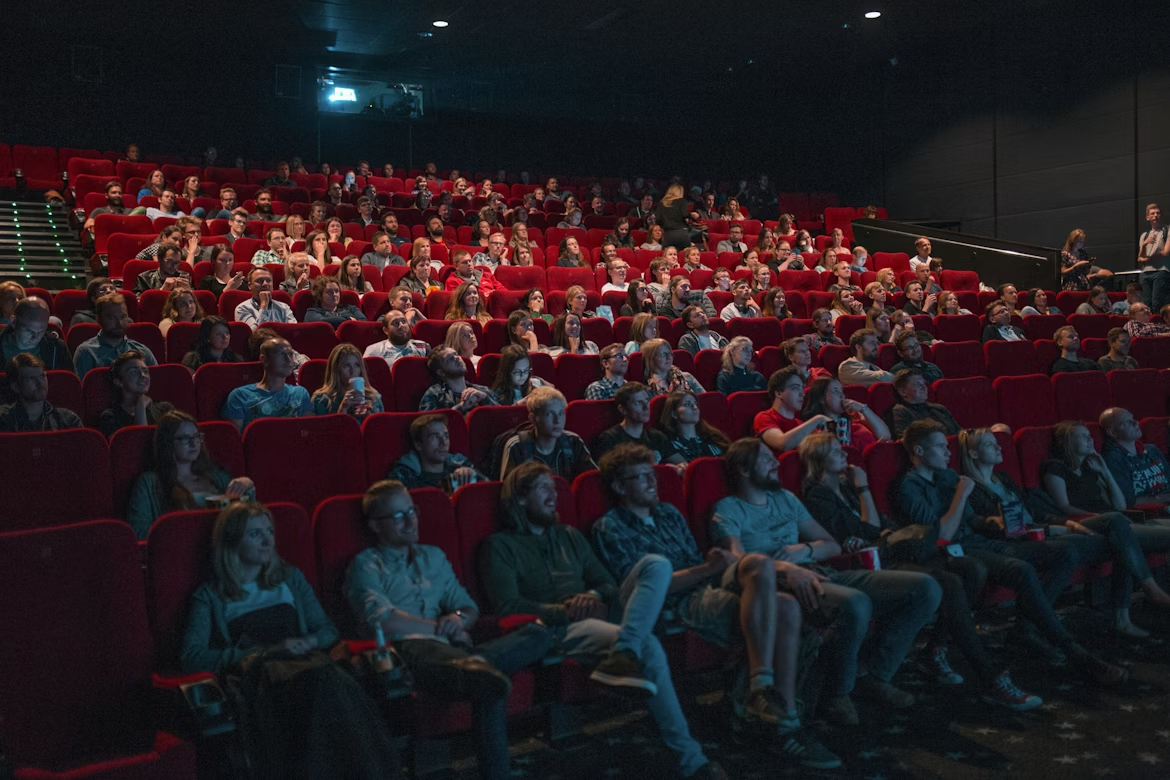
Peter Kuplowsky: I thought the vibes were pretty great. From the audience perspective, every night, people were having right-out fun. There was a really great energy and camaraderie amongst the audience members – but also amongst the audience and a lot of the film teams. It’s rare to see the cast spill out into the street – it happens occasionally, mostly for smaller movies – but it happened a bunch of times, and I think that was just a testament to how much the filmmakers really loved the audience and wanted to connect with them.
B: There was a really diverse range of films this year, from topics to genres.
PK: Every year, I really try to inject a diverse range of films in some way. I have a lot of different films that have opened in different parts of the world, and sometimes I achieve this [range] through [the films of] people coming from distinct cultural backgrounds, or genders, or world views, or genres. If I’m self-critical, I wish I had more international stuff in the selection. But, at the same time, I’m really happy that there was such a variety of genres. Every night was operating [as] a very distinct experience, and even though I had a lot of comedies, I found that the comedies were all very different permutations of them.
B: Exactly, this year did have a lot of cross-genre stuff.
PK: Yeah. What emboldened me to feature a lot of comedies in this year’s edition was how well Tim Robinson and Andrew DeYoung’s Friendship went over last year. To me, it suggested a strong interest in alternative comedy – and that all-comedy works could work in the section.
And to be honest, there were films that ended up in other sections at the festival that might have played Midnight Madness. Films like Maddie’s Secret, for instance, also have a strong alternative comedy component – or Exit 8, which I think is a really strong genre film. In those cases, though, I felt that those films could be served in a better section. Sometimes, it is about setting expectations or calibrating expectations correctly, because I just find that the Midnight audience has such a specific energy. So I tried to find films that could generate interesting reactions.
B: What would you say is the line between an MM film and a non-MM film?
PK: *laughs* My stock answer for the last few years has been that a genre film checks boxes, a midnight film adds boxes that you didn’t know existed before!
It pushes the needle in some way. Expanding on that a little bit, I’ve also looked at midnight films on a spectrum. Where The Evil Dead is on one side, Eraserhead is on the other. You can have a slower film that can work at Midnight, then you can have something that’s more high-octane and kinetic as well. So, it’s not always about momentum, but I do think – for me – what makes a midnight film is that every step of the way, it is blocking convention. It is doing something different, or it is simply entertaining. It’s either entertaining or provoking: It’s doing something with a rhythm, or it cruises a sort of frequency of provocation or spectacle.
B: Before you did Midnight Madness, you were a member of the Cinema Studies Student Union (CINSSU) at U of T, and you programmed for the WTF Wednesday series.
PK: Yeah, WTF Wednesday was initially founded by my good friend Eastern Yu, and then I started working on it with him. Definitely, I would credit Eastern for the idea of that. For the series, we were just like, “Let’s go to Room 222 and show some of the strangest stuff we can find!”
This might be too much information, but I remember that one of the first editions we did, I had rented a 16mm print of The Green Slime, the Kinji Fukasaku film, and then, unfortunately, it landed on the exact same day that CINSSU was invited into a special sneak preview screening of a work-in-progress version of Zack Snyder’s 300. It was not the whole movie – like a 40-minute cut of it. They weren’t showing the whole film, but a selection of scenes that took you through the movie in an accelerated way. Snyder was gonna be there, and literally every CINSSU member said, “We’re gonna go to that instead,” so I had to stay behind and host the screening of The Green Slime while everybody was at this event.
It was like when Bart would go to Itchy and Scratchy the Movie in The Simpsons. And I remember coming back to the office when everyone had returned from 300. I was like, “How was it?” and everybody was immediately like, “Oh, it was unbelievable!!! The greatest thing ever!!” And I remember when I saw the final movie, they were like, “Man, the version we saw at that screening was better than the movie because it was only 40 minutes – just the good stuff!” *laughter*
B: What has become different from when you were doing screenings for CINSSU and now for Midnight Madness?
PK: When we were programming for CINSSU, it was always a group discussion – and I miss how spirited those discussions would be. We would really argue about what we want to play, and sometimes the argument would be like: “That show has played in Toronto recently!” or “This show never plays in Toronto!”
There was like a point someone wanted to make because I wanna introduce the film in a certain way or create a double bill – we’re gonna juxtapose movies.
Trying to remember some of the memorable double bills we did… One was Full Metal Jacket and Eyes Wide Shut. Another good one was Mysterious Skin and Heavenly Creatures.
The thing I miss the most – and now I’m so appreciative of that time – is that there were so many 35mm prints still available from all the major studios. They kept pretty accessible archives. It was just so exciting to book all this stuff on film and not have it be a big detective story where you had to go and track down a print from a private collector. Most of the major studios and their affiliates in Canada had huge archives of 35s, and I feel like we were one of the last eras to have that access to prints – to me, that was so special.
Midnight is a different beast. It’s something I largely do on my own. One of the things I really relish about working in TIFF is that they give programmers a lot of autonomy. I very rarely have to vent my lineup with my superiors: they might wanna play something, I wanna play something, and that’s how it goes.
The challenge becomes that I wanna show stuff I’m interested in and stuff the audience will be interested in. I wanna show stuff the industry will be interested in. I feel especially since the festival finally established a film market, I wanna have a slate that feels like it’s gonna be showcasing new titles that are looking for buyers, so that it becomes an exciting sales market.
But I also want to respect the alumni who are submitting their films. I played a Ben Wheatley film because I knew that the audience likes Ben Wheatley. He won a People’s Choice Award last time he was here, so I knew there was an interest in that film. Dust Bunny as well – it’s a film that had Sigourney Weaver attending Midnight Madness. So, it’s always fun to have a big celebrity component to one or two of the screenings because that’s gonna help anchor in bringing new audiences. You have a great time at that screening, and maybe you’ll decide to come to other screenings to see what they’re like.
B: On that, do you think midnight movies themselves have become a market?
PK: Absolutely. When midnight movies started, it was an exhibitor concept trying to cultivate a new audience during a period of business that wasn’t doing very well. They were like: “What if we keep the theater open at midnight? There are all these weirdos who would want to come and watch. We can play movies for them.” So they started out with El Topo, Kenneth Anger films, and eventually, The Rocky Horror Picture Show.
Shortly after that, festivals started to include midnight sections. Toronto International Film Festival is one of the first to have a dedicated midnight section. I think in many ways it was responsible for institutionalizing the concept of a midnight cinema. And then, before long, the genre films that were premiering in that section began to be very commercially buyable, and now, genre films and horror films have really become a big A-genre. Horror has always been profitable, but there’s definitely a strong interest on a studio level in producing more horror films because the audience loves to come out for them.
But it’s interesting because midnight sections inherently have towed the line between genre and something that’s a bit more experimental, a little more confrontational. I think that’s part of the balancing when I put together a lineup. I want to find films that I think will be crowd-pleasers, and I want to find the films that I think are gonna be divisive and provocative. Even when I schedule it out, I want to start with films that are a bit more unifying and popular – then I introduce stuff that is more divisive and polarizing.
B: Speaking of the order in which you show the films this year. Did you have any concerns about putting Normal after The Furious? Because the latter sets the bar too high on the action.
PK: *laughs* It’s funny, in scheduling, some of it is based on what I’m interested in and simply trying to create a flow. Sometimes it’s also logistical: when are the filmmakers available, when are the talent available? Dust Bunny on Monday was largely due to factors in terms of Sigourney’s availability. That can sometimes supersede creating a sense of flow towards things.
I wanted The Furious in a prime spot. I wanted The Furious also because it’s a movie that will bring this huge cast. It really felt like a culmination of the Midnight Madness section because it contained so many actors who got their start in the program. So many technicians and artisans. Even XYZ is a major selling company. They had a long history in MM, and I wanted to put them in a significant spot in the festival.
Normal’s action is a very different kind of action. I felt it skewed more towards comedy. I felt that we were going to slide towards a more comedic action approach, because I think Dust Bunny [which played the following night] was very whimsical and funny, too. So, therefore, I felt this would be a transition into something like Dust Bunny after the high extremes of The Furious.
But you’re right. Last year, The Shadow Strays ended up being on the last day, and that was largely due to the fact that Timo Tjahjanto was shooting Nobody 2, and he was not available until the final weekend! We really wanted to make that happen. It was also not a sales title. It was bought by Netflix, so I didn’t try to position it for the big sales.
B: Here’s a confrontational question. One of my favorite moments of the festival was when someone yelled, “What the fuck Peterrr!” from the balcony during Fuck My Son!. To what extent do you feel responsible for the movies you show?
PK: I consider myself responsible for all of it. I do encourage people to read my program notes, which I really labor over. I spend like 2 or 3 days on each note, really trying to write something that articulates why I included the film and setting up what to expect without spoiling the story.
*Chuckles*
So, I was surprised by the amount of people who walked out of Fuck My Son! and were surprised at what was in that movie. I feel like I said everything that was in that in the program notes. It’s all there; you shouldn’t be surprised. If anybody ever has any familiarity with the works of John Waters and trash cinema like Nothing But Trouble or a Texas Chain Saw Massacre film, I feel like aesthetically and tonally, there are a lot of similarities between those films.
I even warned people of the use of AI in the movie – which I would defend as this is a movie that intentionally assembles a collage of trash aesthetics. I think it’s impossible to deny that generative AI is a hyper-contemporary trash aesthetic that exists in our world – and the fact that the movie uses that technology during the satirical corporate videos is literally saying, ‘This is how corporations are presenting the moviegoing experience.’ I don’t think it’s entirely inaccurate; a lot of these corporations are using generative AI for their pre-shows.
And then, the other significant use of it is when a young girl starts hallucinating apparitions of the YouTube characters she follows. Unfortunately, I think a lot of children’s entertainment is beginning to be artificially generated – especially on YouTube.
I completely respect anyone who draws a hard line. Certainly, the filmmakers could have pursued handmade approaches to those specific elements in the film. But I do think it was part of an aesthetic project that the filmmaker was doing, and I think it would be wrong to privilege all those effects and ignore all the incredible handmade stuff that’s in the rest of the film: the incredible work Marcia King and Robert Kurtzman did on the prosthetic.
And the performances… I personally think they are terrific camp performances. I think Robert Longstreet’s amazing in the film, and Tipper Newton is a miracle! I write about it in my program notes that she walks this wild tight rope that is almost like a female Bruce Campbell performance. It’s really funny.
B: Building off of AI, I felt like a lot of Midnight Madness films this year were concerned with the internet and social media in some way. I have been noticing some sort of internet brainrot cinema coming into shape in general-
PK: Terminally online cinema?
B: Yeah! How do you think this kind of film will manifest itself in the future?
PK: Well, I’m still waiting for a festival to start playing TikToks. Like a movie you just watch in a loop, multiple times.
I mean, it’s beginning to happen, the new wave of liminal horror films, like Skinamarink, speak to this kind of terminally online cinema. We’re gonna get a Skibidi Toilet movie, aren’t we?
B: Yeah, by Michael Bay!
PK: Haha, apparently it exists – currently being developed.
I’m trying to think about my lineup with respect to social media. A film like The Napa Boys absolutely is a movie with a meta component to it. One of the ways to fully enjoy it is to acknowledge the meta elements of the all-comedian personas that are in the film and what they are doing both on-screen and off-screen; and how they discuss the film and how they represent the film.
I’m trying to think about how it factors in the other films. A movie like Obsession is by a YouTube creator – so there’s a component there. He made a very classical horror movie. I don’t think it necessarily speaks to any contemporary social media aesthetics. Though I suppose you could say that the film maybe was inspired by the Overly Obsessed Girlfriend meme!
*Laughter*
B: Karmadonna was actually on my mind.
PK: Well, Karmadonna is full of angry rhetoric towards social media culture and the contemporary cultural mysteries that we, the filmmaker and the characters in the film, take offense at, from toxic influencers to media producers who are exploiting their forces. In the case of Karmadonna, one of them is really the son of God.
The more I talk it through, I do appreciate the throughline. I don’t think it was necessarily conscious – it wasn’t like I really wanna combine a bunch of movies that are speaking to internet culture.
At a certain point, I really did appreciate how many comedies I was playing, and I decided to lean in that direction because I was interested in how each comedy was coming at it in a very distinct way. Both Nirvanna (The Band The Show The Movie) and The Napa Boys are very anarchic but very much indebted to their love of cinema and cinema conventions. But they approach the expression of that in a very distinct way.
B: And I thought it was very fitting to open and end the program with local films [Nirvanna and Dead Lover].
PK: I love that! Once I saw Dead Lover and Nirvanna – and loved both of them – that’s when I began to think it would be really cool to bookend the section with these two movies that are pretty Canadian films that are not launching in the festival but rather have developed cult followings internationally and are now coming home for their Canadian premieres.
I think that demonstrates that we’re in a real exciting period for English language Canadian filmmaking. There are some really strong voices that are making very idiosyncratic and interesting cult films, which are performing on an international level.
I also love that we ended our program with not just a local film, but a film that fully embraced the midnight movie experience in the tradition of exhibitors who did midnight movies also by having the Stink-o-vision scratch-n-sniff parts. I think that was such an awesome interactive element that further advanced the screening.
It’s funny too when you juxtapose it with Nirvanna, which also had interactive elements to the screening that had surprise cast members in the audience and the RV from the movie pulling up at the corner of the theater. So, a lot of these midnight movies do try to engage with these meta extra-curricular activities.
But also, I like how Nirvanna is also super hyper-contemporary given its aesthetic and Dead Lover harkens back to the aesthetics of the original Midnight Movies – like a cult genre movie they made in the 20s and 30s, with one of the most primordial midnight stories which is Mary Shelley’s Frankenstein – which has been reinvented time and time again, including at the festival with Guillermo del Toro’s Frankenstein, but certainly also in a lot of midnight contexts like Frankenhooker or Reanimator. It was really cool to bookend with. I liked the symmetry of that. But I can’t say all this stuff is planned in advance; some of this, you just feel it out when you’re assembling.
B: And people love your intros too! People still talk about The Substance’s workout bit. I think the song you sang before Dead Love will be spoken about for the next couple of years.
PK: Oh, I’m so glad. I’m such a theatre ham, and now that Midnight Madness has gone to technically Toronto’s equivalent of the Broadway stage [Royal Alexandra Theatre], I always want to get up and sing. I’m glad it’s appreciated.
When I do those intros, one of the reasons I do the hat toss is that I know I miss most times, and I like the idea of failing in front of everybody – it makes me more of a jester and a fool. And I think it puts the filmmakers at ease because sometimes they are nervous about going outside – but if they see I just slipped up and did something silly on stage, I think it reduces the stakes for them. It makes them go, “It’s not super severe or doesn’t have to be super serious, and if anyone’s gonna embarrass themselves on stage, it’s Peter. It’s not gonna be me.”
And I try to bring a lot of energy because I recognize there are people in the audience who have seen more movies that day. I recognize that it’s late and that people watch midnight movies a lot less. It’s less of an exhibition concept in regular movie theatres. So, I think it is rare for people to stay up late and start watching movies at midnight, and I think people, with variations, tend to get tired a whole lot quicker, so I’m really like, ‘How can I captivate this audience? How can I really hype them up, so when the movie starts, they are at the most frenzied they can be, so there is no risk of them nodding off too soon?’
B: Thank you so much for speaking to us, Peter. Is there anything you would want to say to the Herald readers?
PK: My brother used to run The Innis Herald.
B: Really?!
PK: Yeah, so the Herald is very dear to me. I remember he dedicated an entire issue to our now-deceased cat. So, I fondly think of the Innis Herald, and it was always a great friend to CINSSU – they were next to each other. It’s an honor and privilege to be interviewed by the Herald, so thank you for the opportunity.
B: Well, thank you for taking your time. Hope the movie production goes well!