The Trio/Il Triello—The Greatest Standoff in Cinema History
I watch a lot of movies. I love movies. But every once in a while, you watch a movie that you know is going to be an absolute blast. The reputations precede the quality, and sometimes, they even match it. The best experience is watching a film with a good reputation that has a quality that is ten times more powerful than anything people say about it.
That’s how I feel about The Good, The Bad, and the Ugly (1966), directed by the legendary Sergio Leone, and starring Clint Eastwood, Lee Van Cleef, and Eli Wallach. I love the entire Dollars Trilogy, which includes A Fistful of Dollars (1964) and For A Few Dollars More (1965)—hard to believe he made three masterpieces in a three-year period! But those two masterpieces culminate in the nearly three-hour epitome of spaghetti Westerns, which capped off this trilogy in the most masterful way in cinema. Directors like Quentin Tarantino consider this the only real masterpiece trilogy that didn’t fall off after the second film, and I have to agree. Up there with the Lord of the Rings and Toy Story trilogies, these three films knock every other film trilogy out of the park, delivering solid performances, killer Morricone soundtracks, stellar cinematography, and captivating gun-slinging action plots that keep you engaged for hours.
I think the culmination of this culmination comes in the climax of The Good, the Bad, and the Ugly, commonly referred to as “The Trio,” a three-way Mexican standoff, layered with the most intense Ennio Morricone track known to man, and visually presenting nothing other than three men staring back and forth at each other for five minutes straight. What should be the most boring scene ever is so masterfully shot and edited that it delivers the most intense and suspenseful final duel ever shot on film.
Let’s rewind back a bit. The scene starts with Tuco—the Ugly—desperately digging Arch Stanton’s grave with his hands, in the hopes of finding the treasure that the whole film has revolved around finding. The Man with No Name, Blondie, The Good, whatever you want to call him, shows up, his iconic waa waa waaaaaa stinger introducing him as he throws Tuco a shovel. “It’ll be a lot easier with that,” he taunts. Tuco begrudgingly starts digging, one hand on his gun holster. Out of nowhere, another shovel is thrown. Angel Eyes enters the scene. The Bad! Apparently, horses in the Civil War could gallop with zero sound emitted. These two basically teleport in, scaring the others with their entrances! “Two can dig a lot quicker than one. Dig,” Angel Eyes says. Does he know who he’s talking to? Each time Clint Eastwood bites his tobacco cigar, an angel loses its wings! Who does Lee Van Cleef think he’s bossing around? Blondie lights a match and continues smoking his cheroot. Angel Eyes cocks his gun. Tuco grimaces. Blondie continues smoking stoically. “If you shoot me, you won’t see a cent of that money.” He kicks up the coffin and reveals the skeleton inside. Here lies Arch Stanton. Tuco pays his respects. In real life, that skeleton was set decorator Carlo Leva’s real mother’s remains, who had been an actress, and was left as a “skeleton for hire.” Some actors just can’t get enough spotlight, apparently.
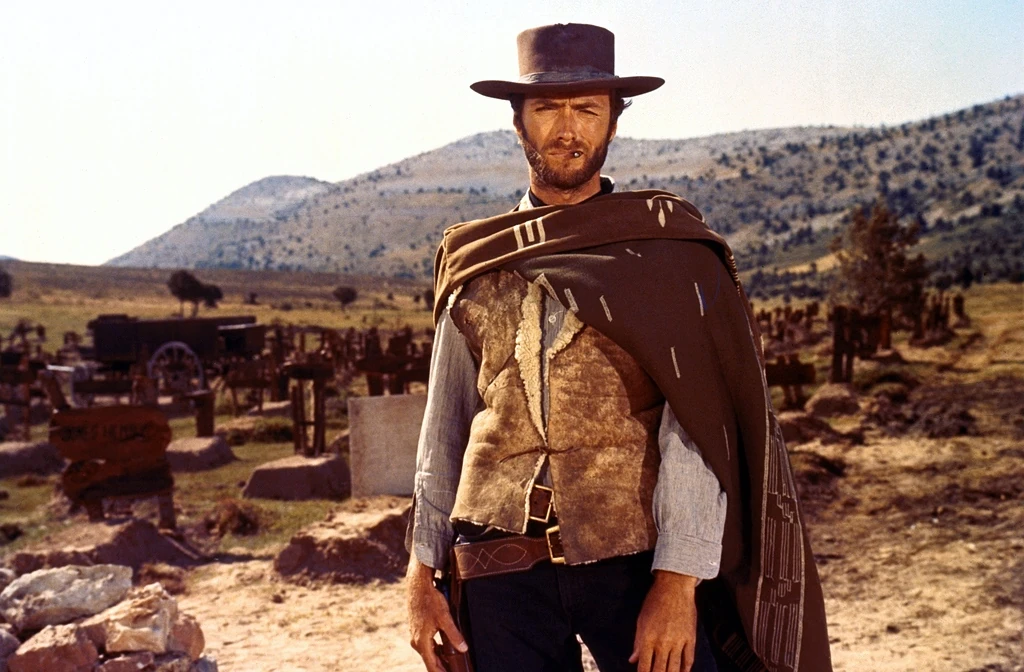
So what happened to the money? The $200,000? A lot of money in the 1860s, I bet. Blondie remains one step ahead of Angel Eyes and Tuco the entire scene, controlling them without even holding his gun. His weapon is his mind, which holds the secret that they all want access to. Wearing his iconic brown and earth-toned poncho, Blondie walks into the center of the cemetery to a large stone-laden centerpiece. He picks up a rock, writes something underneath it, and places it in the middle. That’s it. The prize. The prize that the whole movie has been leading up to. Two and a half hours of traveling, killing, surviving, just to be so close to this treasure. Why doesn’t Blondie just kill them both and keep the treasure? Because he’s the Good. He is cool, calculated, stoic, and honorable.
And so, the Ennio Morricone track comes in. How beautiful this piece of music is. How many times I’ve done PRs in the gym to this song! What’s about to happen next becomes apparent. A three-way final duel, the only way to end a three-part trilogy; the climax to this unholy trinity. They slowly begin to form a triangle, each taking a corner in the huge rock-laden circle amid the beautiful Sad Hill Cemetery, shot in the vast plains of Spain. As the blaring trumpet theme erupts through the screen, we cut to an extreme wide shot, showing us everything from a bird’s eye view. They each take their corner. Tuco on the left, Angel Eyes in the middle, Blondie on the right. The harsh musical triads erupting from the trumpet perfectly mirror the three of them standing off in sharp opposition, waiting for the right moment to shoot.
The masterful Sergio Leone introduces the fight with this climactic cornet theme, then cuts it off in an instant, as we hear nothing but birds cawing and wind blowing. Complete contrast. Masterful. We get a cowboy shot of each of them, as they eye up both of their opponents. A shot of each of their waists, guns strapped and ready to go. A medium close-up on each face, stoic and waiting to strike. Then, a close-up. We see their internal battles. Tuco, wide-eyed and frantic. Angel Eyes, cunning and calculated. Blondie, stoic and confident.
Then… the trumpet returns, triumphantly raising your adrenaline and pumping the scene back into full gear. Something is about to happen! Someone is about to die. Are you on the edge of your seat yet? For a full MINUTE, we see back-and-forth shots of their faces, eyes frantically jumping back and forth, calculating their next move, hands on their guns, standing off in pure menace. The music crescendos, the tempo rises, the shots get tighter, the suspense is at an all-time peak, AAAAANNNNNNDDDDDDD… in one second, six shots are edited, as the climactic duel ends with Blondie shooting Angel Eyes, and knocking him down. Hoooolyyyy crap, dude. Tuco’s gun doesn’t work… typical. It is clear that Angel Eyes and Blondie both had it out for each other, recognizing the mutual threat. Tuco likely went for Angel Eyes too, so he stood no chance. In a tight shot depicting desperate malevolence, Angel Eyes gets ready to shoot Blondie, but is finished with a second shot. He is literally thrown into an empty grave. How fitting. And a third shot to confirm the kill.
I won’t spoil what happens next as the film comes to a close between our favorite duo, Eastwood and Wallach, but with the Bad out of the picture, this intense climax comes to a close, and the Trio soundtrack fades out as the shots of Angel Eyes’ death ring out. I can’t imagine this scene without Ennio Morricone’s fantastic soundtrack, which, as I explained, really completes these films. Without Morricone’s soundtrack in all three of these films, I can’t imagine they would be as popular and timeless as they are. There’s nothing else quite like the Sergio Leone and Ennio Morricone duo in cinema. The Trio is a masterclass in filmmaking, showing that a simple scene cutting between three characters for 5 minutes can be a masterpiece if you apply the right techniques and hone down all the elements that make it so great. I can’t think of a more exciting, satisfying, well-edited, audibly exhilarating, and well-performed scene in any film in the history of cinema. Can you?